
Applications for Oxide-based Glasses and Glass-Ceramics
Calculate the following based on your actual alloy chemistry:
Application Examples
Predict Phase Stability in Oxide Systems Exposed to Air
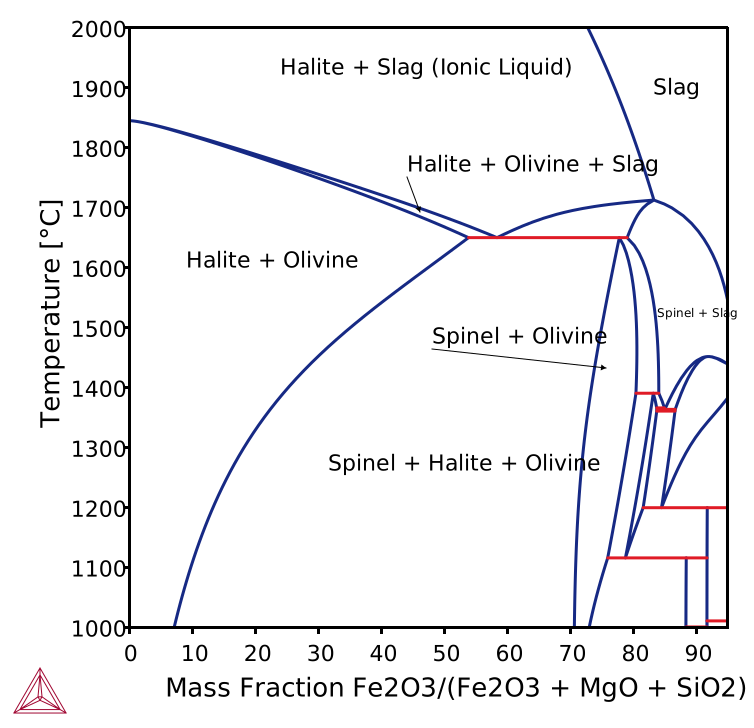
Determining how temperature, composition, and atmospheric conditions affect phase stability is important when working with multicomponent oxide materials. In the MgO-Fe2O3-SiO2-O2 system, these variables determine whether the material is fully liquid or forms phases such as halite, olivine, and spinel. Thermo-Calc can calculate these relationships while accounting for oxygen exchange with the surrounding atmosphere, helping users identify the conditions needed to maintain a liquid melt or promote/avoid particular crystalline phases.
The figure shows the calculated phase stability of the MgO-Fe2O3-SiO2-O2 system in air, with SiO2/(MgO + Fe2O3 + SiO2) fixed at a mass fraction of 0.05. At lower relative Fe2O3 contents, the solid phase regions are dominated by halite and olivine, while spinel-containing regions become stable as the Fe2O3 content increases. At sufficiently high temperatures and Fe2O3 contents, the system is predicted to be fully liquid. The oxygen activity is fixed to represent an open system exposed to air, meaning oxygen is entering and leaving the system continuously. This allows the calculation to account for both Fe+2 and Fe+3, even though the iron content is expressed as Fe2O3.
Calculate Heat Stored in Glass Melts
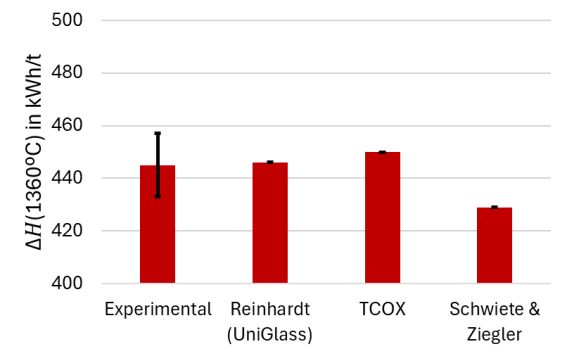
Properties such as enthalpy of the system can provide useful information such as heat stored in the melt. Such information can help manufacturers optimize the energy required to produce certain glasses in an industrial process [3]. The energy required to produce the melt can be expressed as:
Hex = (1 − yc).ΔH0chem + ΔH(Tex)
In this equation, ΔH(Tex) represents the heat physically stored in the melt at the exit temperature Tex. This value can be calculated in Thermo-Calc using the Metal Slag and Oxides Database (TCOX). The figure here compares experimental and calculated values of ΔH at 1360⁰C for an insulation wool glass [58.2SiO2-1.1Al2O3-3.4Fe2O3-9MgO-23.5CaO-4.6Na2O-0.2K2O, composition by weight]. Compared to experimental results, the TCOX database predicts this value well and is similar to the Uniglass predictions. It should also be noted that if the glass contains elements with mixed valency (such as Fe, Mn, Cr…) then some of the energy may be stored as chemical energy and released through oxidation or reduction reactions.
Predict How Composition and Temperature Affect Melt Viscosity
The viscosity of the oxide melt (slag) is considered one of the most important parameters during blast furnace operation, steel refining, and manufacturing of oxide-based glasses or glass-ceramics. Particularly for glass-ceramics, the rate of crystallization from the melt is directly proportional to viscosity, as discussed later. Relatively small changes in composition can alter viscosity by several orders of magnitude due to changes in the short-range structure of the melt [4,5]. Thermo-Calc can calculate viscosity as a function of actual composition and temperature using the Metal Slag and Oxides Database (TCOX).
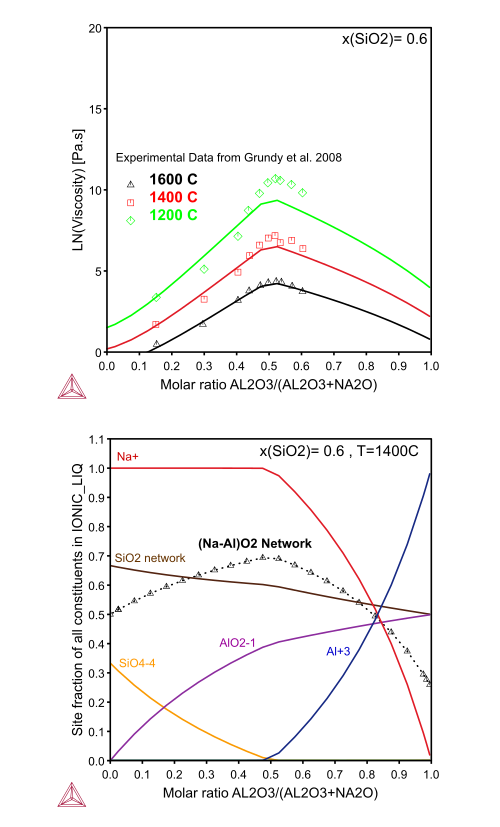
The top plot shows an example of viscosity calculated for the Na2O-SiO2-Al2O3 system at 1200, 1400, and 1600 ⁰C, compared to experimental results from [5]. The calculation shows that viscosity decreases as temperature increases and reaches a maximum when Al2O3 and Na2O are present in a 1:1 molar ratio. This is caused by the charge compensation effect by which one Na+1 and one Al+3 ion combine and behave like a single Si+4 ion, thereby forming a coherent network that results in a dramatic increase in viscosity. This structural change in the oxide melt is well described in the two-sublattice model for ionic liquids available in the TCOX database [6,7].
The bottom plot shows how the fractions of species on the 2 sublattices change when replacing Na2O with Al2O3. The dotted line with marker (triangle) is the average sum of AlO2-1 and Na+1 species contribution to IONIC_LIQ (Ionic Liquid). They reach a maximum at the 1:1 molar ratio following the same trend as the viscosity plots.
Predict Crystal Growth Rates for Glass-Ceramics
Controlling crystallization is essential when developing glass-ceramics because crystal growth rates influence the phases and microstructures that form during processing. Ueberricke et al. [8] have successfully shown that a CALPHAD-based approach can be utilized to accurately predict crystal growth rates for glass-ceramics. They calculated and experimentally validated this for more than 30 glass-ceramic chemistries using the popular Turnbull-Hillig expression as shown:

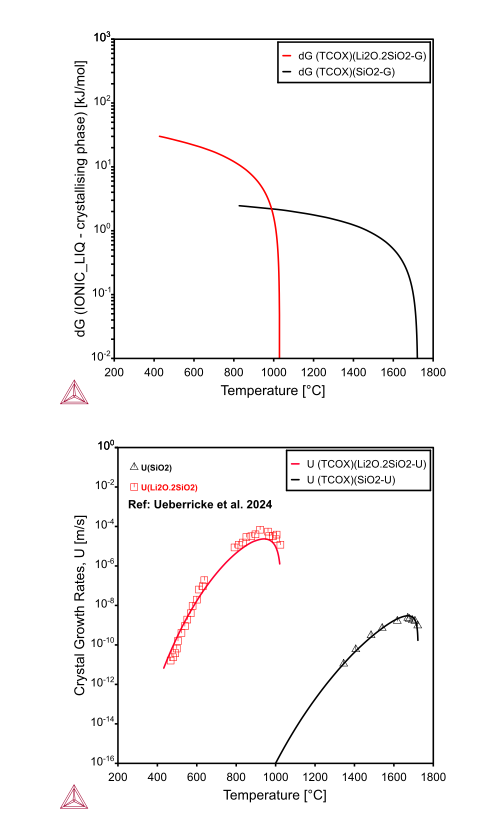
In the Turnbull-Hillig expression, 𝜂 is viscosity (Pa.s) and ΔG(T) is the Gibbs free energy difference between the IONIC_LIQ and the crystallizing phase (kJ/mol). Both these values can be calculated for the glass-ceramic system of interest using the Metal Slag and Oxides Database (TCOX). The terms kB and R are the Boltzmann and Universal Gas constants respectively, while λ is the jumping distance (m), assumed as 1E-10 m (or 1 Å). Additional coefficients are considered for other growth mechanisms, as described in [8].
The top plot shows the Gibbs energy curves for pure SiO2 and Li2O.2SiO2 as a function of temperature. The bottom plot shows the resulting crystal growth-rate predictions compared with data from Ueberricke et al. [8]. Both the Gibbs energy curves and viscosity values were taken from the TCOX database. In the case of Li2O.2SiO2 with crystal formation on Screw dislocations, the molar volume was also taken from the TCOX database. The calculated curves closely reproduce the published growth-rate data across the temperature ranges shown, demonstrating how properties calculated with TCOX can support reliable predictions of crystal growth.
Learn more about Applications to Oxide-based Glasses and Glass-Ceramics

Accurate Viscosity Prediction for Molten Slags: A New Model and Database