
Applications for High Entropy Alloys
Calculate the following based on your actual alloy chemistry:
Application Examples
Calculate Multicomponent Phase Diagrams
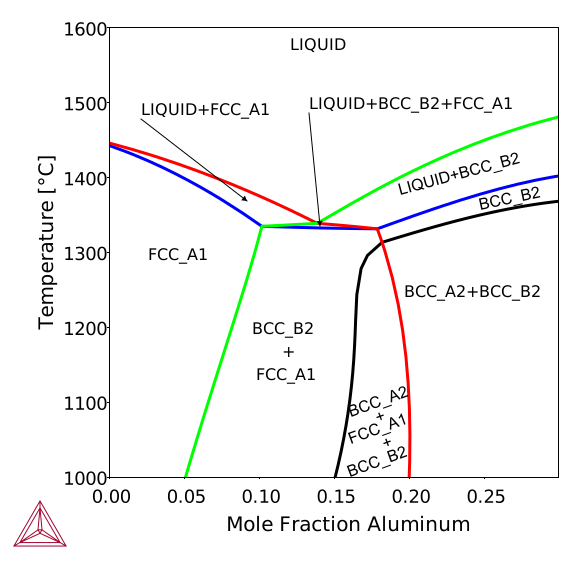
CoCrFeNi is one of the most studied HEA alloys. It has a narrow solidification temperature range and is single phase disordered FCC_A1 across a wide temperature range. An ordered precipitate phase could increase its high temperature strength. Thermo-Calc can be used to explore chemistry ranges and modifications to tailor phase balance for optimum properties.
This phase diagram for CoCrFeNi-Alx shows how additions of Al change the phase stability. At higher amounts of Al, ordered BCC_B2 phase is predicted to be stable. At even higher Al contents, the matrix phase switches to a BCC_A2 disordered phase.
Calculating Stability Diagram for Undesirable Precipitates
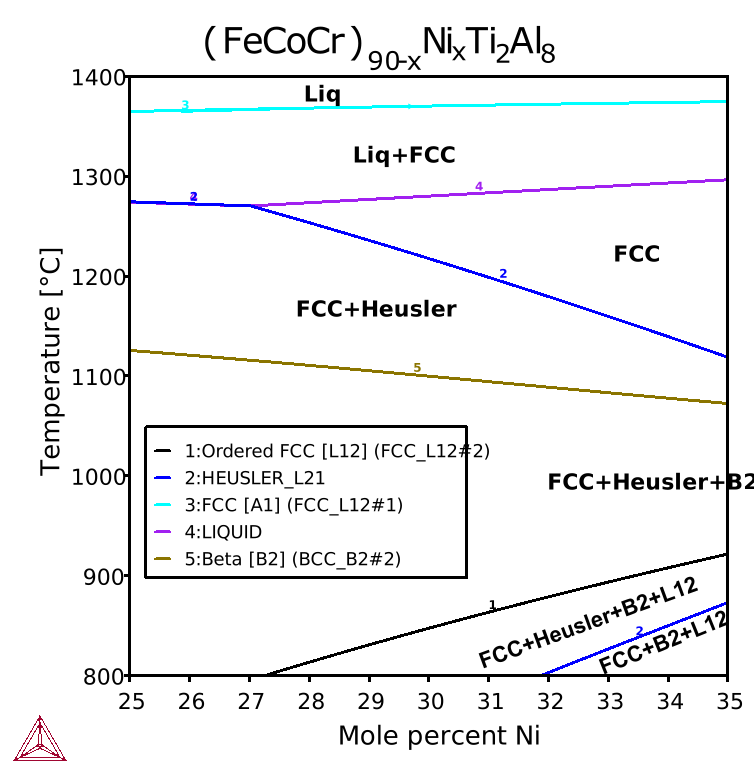
A Heusler phase with an incoherent L21 structure can be detrimental in FCC strengthened HEAs where the main strengthening precipitate is expected to be a coherent γ’ (L12 structure) type precipitate. Thus, for chemically complex HEAs, the amount of Ni, Al, and Ti drives the precipitation behavior of the material. It is, therefore, useful to use phase stability diagrams to look at composition-temperature ranges wherein such undesirable phases are present and minimize them.
Based on work from [Zhang, 2022], the figure shows an isopleth of (FeCoCr)90-xNixTi2Al8 (at%) showing the engineering composition-temperature range for FCC HEAs with precipitation-strengthening attributes to Heusler and other ordered phases such as γ’-L12 at low temperatures. The plot was produced using the High Entropy Alloys Database (TCHEA).
Learn more about Applications to High Entropy Alloys

Navigating the BCC-B2 refractory alloy space: Stability and thermal processing with Ru-B2 precipitates

Using CALPHAD-based Tools for the Study and Design of High Entropy Alloys
Mixing Entropy of Exact Equiatomic High-Entropy Alloys Formed into a Single Phase
Solid Solutions with bcc, hcp, and fcc Structures Formed in a Composition Line in Multicomponent Ir–Rh–Ru–W–Mo System