John Ågren Receives 2026 Adolf Martens Memorial Steel Lecture Award
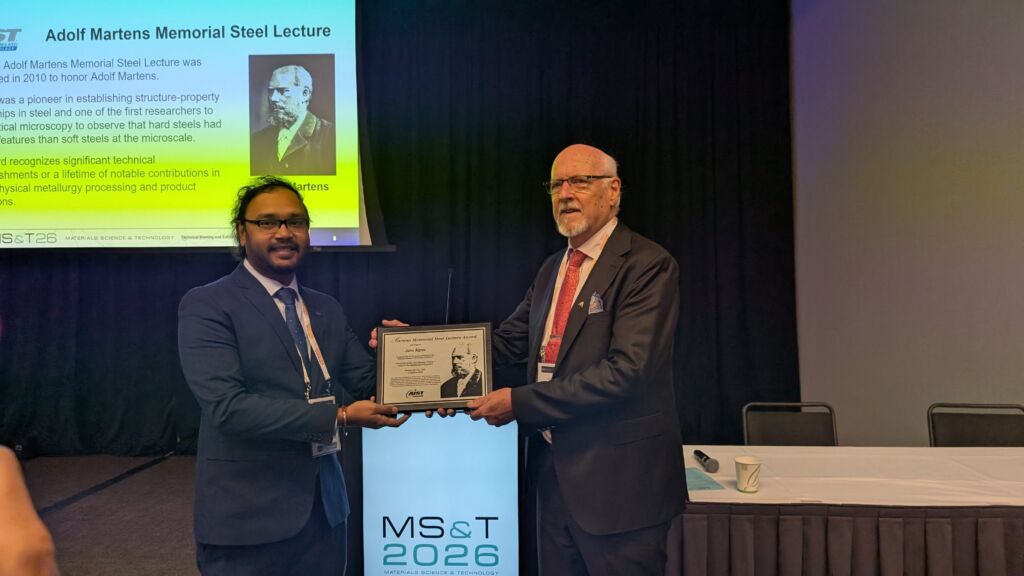
Prof. John Ågren (right) receives the Adolf Martens Memorial Steel Lecture Award at the MS&T Conference in Pittsburgh, Pennsylvania, on October 6, 2026. The award was presented by Dr. Venkata Natarajan (left), Officer of the AIST Metallurgy Processing, Products & Applications Technology Committee.
Established in 2010, the award recognizes significant contributions to physical metallurgy that have advanced the processing and application of steel. It honors Adolf Martens, a pioneer in understanding the relationship between the structure and properties of steel.
Connecting Fundamental Science with Industrial Applications
In his lecture, Prof. Ågren reflected on how advances in computational thermodynamics and diffusion modeling have transformed the way metallurgical engineers tackle complex industrial challenges.
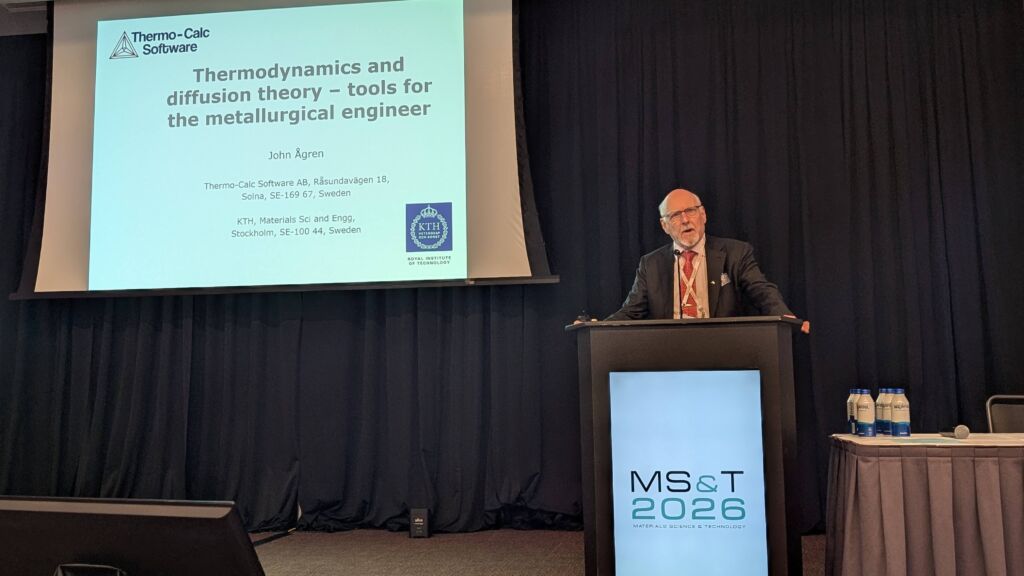
Prof. John Ågren delivering his award lecture, “Thermodynamics and Diffusion Theory—Tools for the Metallurgical Engineer,” at the Materials Science & Technology (MS&T) Conference in Pittsburgh, Pennsylvania, on October 6, 2026.
While thermodynamics and diffusion theory have long been essential parts of materials science, applying these principles to real-world engineering problems was historically far from straightforward. Industrial alloys contain multiple elements and phases, and their processing involves constantly changing conditions that are difficult to describe using simple textbook models.
Prof. Ågren has played a key role in helping bridge that gap. His work on multicomponent diffusion theory and the development of computational tools such as the Diffusion Module (DICTRA) has enabled engineers and researchers to better predict how microstructures evolve during industrial processing.
His lecture highlighted how CALPHAD-based thermodynamic and kinetic modeling has grown into a cornerstone of Integrated Computational Materials Engineering (ICME), allowing engineers to apply fundamental scientific understanding to practical challenges in alloy development, heat treatment, and materials processing.
Helping Shape Thermo-Calc Software Since the Beginning
Prof. Ågren was among the founders of Thermo-Calc Software in 1997 and has served as Chairman of the Board since 2001. From the beginning, he championed the idea that advanced materials science should be translated into practical tools that engineers can use to solve real-world problems. That philosophy has played an important role in shaping Thermo-Calc’s development and long-term direction.
Today, the same vision continues to guide the company’s mission to accelerate materials innovation through trusted software, data, and expertise. The scientific foundations that Prof. Ågren helped establish remain central to Thermo-Calc’s technology, supporting researchers and engineers around the world as they develop new alloys, deepen their understanding of materials behavior, and optimize manufacturing processes.
Congratulations, John, on this well-deserved recognition!
We are proud to see Prof. Ågren’s contributions to materials science and engineering recognized by AIST. His work has helped bring fundamental scientific knowledge into practical use, and its influence continues to be felt across the materials community and at Thermo-Calc Software.